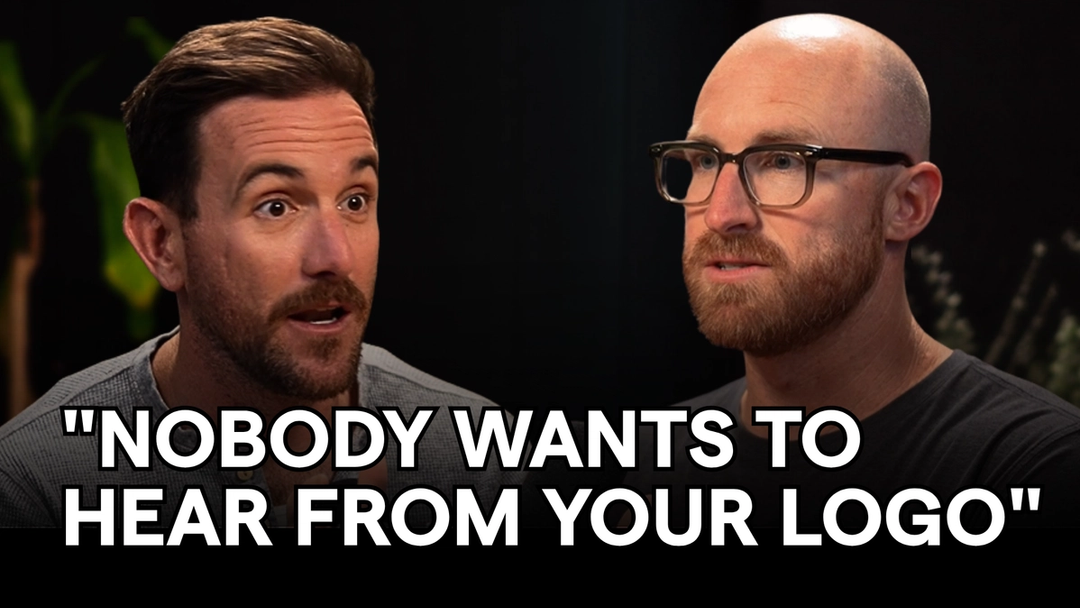
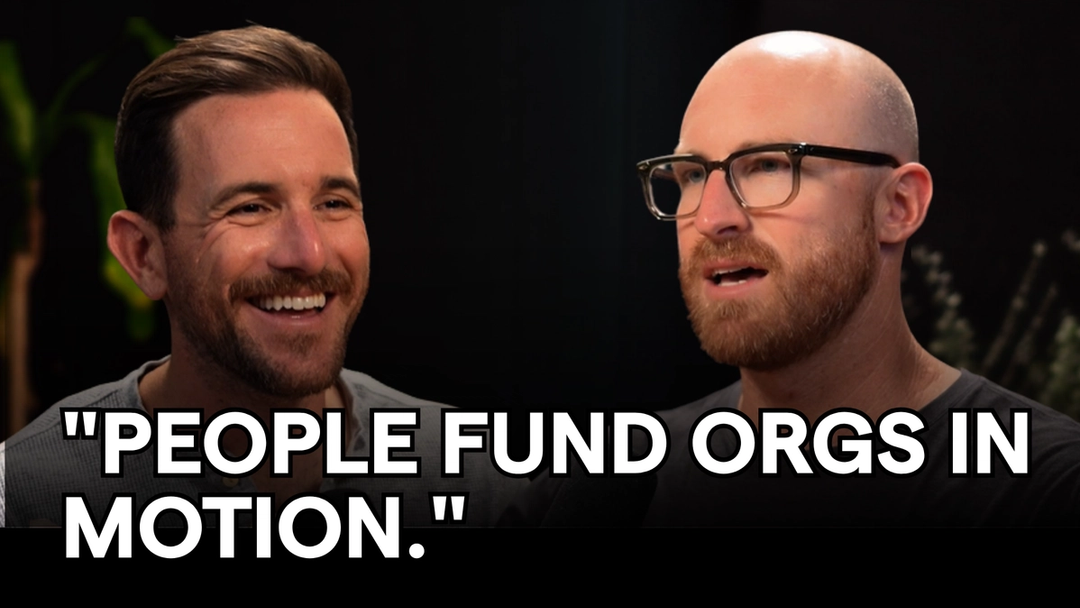
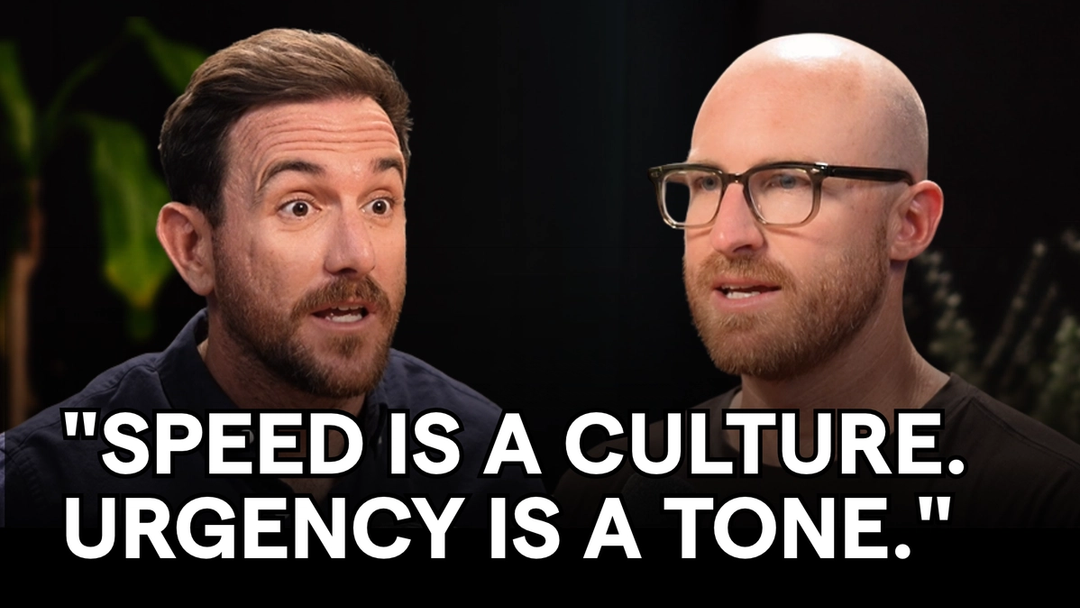
People want to hear from the humans behind a brand, and brand communications now land in the spam folder. Jonathan and Eric talk about building a leader’s voice that strengthens the organization behind it.
Most organizations still put everything out under the brand name and keep their people in the background. I think that’s a mistake right now. The channels are so noisy that brand communications might as well go straight to the spam folder. People expect to hear from the humans behind an organization, from entry-level staff all the way up to the CEO.
Jonathan asked me about this because he's living it. He launched Science, Solutions, Santa Cruz through the Seymour Center, the show is growing, and he's wondering whether he's building the center's brand or his own. His real worry is what happens to the organization the day he leaves.
I've faced the same question at Cosmic. With a team of about eight, I decided our brand would speak through two places: the company accounts and my own. That works because I own the business, I have the strongest opinions, and I chose to be visible. I would never make posting a condition of someone's design job. Being a public face is stressful, and people should opt in.
A leader's voice and the organization's brand can grow together. When Jonathan shows up as himself, the Seymour Center becomes easier to trust, and the awareness he builds stays with the institution after he moves on. The next director brings their own personality and carries it forward. He's already seen donations come in because of guests on his show.
My test is whether the work is good for me professionally and good for Cosmic at the same time. The point where I'd pull back is when content becomes a performance.
If your board is hiring its next executive director, ask how well each candidate communicates and whether they're willing to be the face of the mission. That belongs in the job description.
Episode Highlights:
[00:00:00] Why every organization needs a human voice [00:01:10] Building the Seymour Center brand or the Jonathan Hicken brand? [00:02:35] Personal brand and organizational brand as a yes-and [00:02:55] Why brand messages now land in the spam folder [00:04:05] What happens to the organization when the spokesperson leaves [00:06:15] Does the spokesperson have to come from the top? [00:07:35] How Cosmic decided who speaks for the brand [00:08:30] Why posting on social shouldn't be a job requirement [00:09:10] Hiring an executive director who can be the face of the mission [00:11:50] Spokespeople from Mad Men to TikTok [00:13:50] What Designing Tomorrow has done for Eric and Cosmic [00:16:55] Is a podcast actually driving results for the Seymour Center? [00:18:25] Signals that a personal brand has gone too far [00:21:05] The chicken dinner standard
Notable Quotes:
You would be crazy to not have any personal branding in your organization right now.
Eric ResslerFounder & Creative Director
We look at brand communications and it might as well just go in the spam folder at this point.
Eric Ressler
I worry about having too many eggs in the Jonathan Hicken basket versus the incredible team that's here.
Jonathan HickenExecutive Director, Seymour Marine Discovery Center
There's already been a knowledge transfer of my thinking that attracts the people I want to work with and repels the people that I don't want to work with.
Eric Ressler
I learn a ton by running my show. I am able to test some ideas and develop some ideas through the interviews that I do.
Jonathan Hicken
If you start to tip into being performative, that's where I would personally draw the line.
Venus Spirits: mentioned at [00:21:20], the Santa Cruz spot behind the chicken dinner standard.
P.S. — Struggling to align your message with your mission? We help social impact leaders like you build trust-building brands through authentic storytelling, thoughtful design, and digital strategy that works. Let's talk about your goals »
Full Transcript:
Jonathan HickenExecutive Director, Seymour Marine Discovery Center
All right, Eric, I blame you for this episode.
Eric ResslerFounder & Creative Director
Okay, let's hear it. What am I guilty of?
Jonathan Hicken
Well, listeners may know that you helped build this studio, you designed it, we executed, but this was your creative baby.
Eric Ressler
I'll take a good amount of that credit, but you were part of this.
Jonathan Hicken
Yeah, yeah. Listeners may also know that I started another podcast called Science, Solutions, Santa Cruz through the Seymour Center.
Eric Ressler
It's a banger. You guys got to listen.
Jonathan Hicken
Yeah, it really is. We've been getting some great feedback and we're getting really great listenership. And one question that is occurring to me is, am I building the Seymour Center brand or am I building the Jonathan Hicken brand? Can those things be separated? Is this a slippery slope? And I want to unpack this idea of personal brand and organizational brand, the benefits and the pitfalls of having a visible spokesperson.
Eric Ressler
Yeah. Okay. So you're trying to figure out how to become a mega influencer.
Jonathan Hicken
40-year-old white guy, let's go.
Eric Ressler
Yeah. This is, I think, a really timely question actually. And I'm happy to share my thoughts and my experience with... I've got a similar thing between the work that I've done for building Cosmic's brand out and also through the podcast and intentionally choosing to do that under a different brand or a sub-brand. So yeah, let's go. Where do you want to start?
Jonathan Hicken
Well, let's start with the benefits and pitfalls of having an individual as the visible spokesperson, almost like carrying the brand versus the organization as a whole carrying the brand, and when you see one is more appropriate than the other or challenges with each.
Eric Ressler
So my overall take on this is that this is not an either or, this is a yes and. I also think you would be crazy to not have any personal branding in your organization right now. To have everything come only from the org and not from people in my mind is a huge mistake.
Jonathan Hicken
Why?
Eric Ressler
Because everyone wants to and expects to, at this point, hear from brands and have relationships with brands through the people that are behind that brand, from entry level staffers all the way up to CEOs. If you think about even the biggest tech companies right now, you know the name of the CEO of all the big tech companies, right? And that's been something that's been true for a long time. I think more than ever, especially because of how noisy the channels are, we look at brand communications and it might as well just go in the spam folder at this point.
And so I think the uncomfortable truth, one that I've been dealing with at Cosmic even, is how do you authentically balance having people be the messengers for your brand, the people that either work at your organization or are in partnership with it or are supporting it, and at the same time maintain a brand that is not dependent on any one person?
Jonathan Hicken
How do you do that?
Eric Ressler
Yeah, that's the million dollar question, man.
Jonathan Hicken
Yeah, because that's one of my worries, right? If I'm building my own brand and Seymour Center's brand simultaneously, and then for one reason or the other, I need to leave Seymour Center, where does that leave Seymour Center? And I want to steward the organization well after I leave, whenever that may be. And I worry about having too many eggs in the Jonathan Hicken basket versus the incredible team that's here and the incredible volunteers and the incredible decades of work that's happened here. And I worry about that risk of when this day of separation does happen, what that means for the organization.
Eric Ressler
Well, I would hope that whoever takes over the helm, if and when you decide to depart, will also be bringing their humanity and their individuality and their personality into the brand too, and take that baton and carry it forward in their own way, which will be very different than yours. But again, I think these two things should be complementary. As you are building the Jonathan Hicken brand, or let's say even more so, essentially being a human person, spokesperson for the institution, you are building the Seymour Center brand more effectively because you are humanizing the brand.
Because when you think about brands and organizations and companies, at the end of the day, they're just made up of people, right? They're made up of people and those people are upholding a vision, they're upholding a set of values and standards. They're upholding whatever it is that they create for the world, whether that's impact or a product. But end of the day, companies, organizations are just groups of people working together.
And so leaning into that is I think a trend that's been, this has been true for a long time to some degree. CEOs have always had influence in terms of the communications of the brands that they represent or that they lead. But I do think it's become, especially because of social media and the way that we all communicate with one another, more and more important that there is a human element to brand communications.
Jonathan Hicken
There may be listeners out there who aren't CEOs or executive directors thinking to themselves right now, "I could be the spokesperson."
Eric Ressler
Yes.
Jonathan Hicken
So do you think that the brand needs to come from the top, or how would you think about who is the right person, so to speak, to carry the flag of the brand?
Eric Ressler
I think it depends. I don't think it always has to come from the top. Definitely there's some examples of brands who have elevated individual storytellers or even marketers within the organization that use their individuality to help market and to show up as a person who's part of the team. I think the reason that that can be a little riskier is that dependent on their role and their ambitions, they may not continue with the organization. So that's the big fear: okay, so we platform someone on the team who doesn't have as much of a stake in the game as the executive director or the CEO might, which again, there's edge cases to that too. And then we spend all this time building their personal following on these channels and they leave. Is that a loss fully? I don't think it's a loss fully, because as they are building awareness for the brand through themselves, that awareness doesn't disappear overnight when they leave, but it does leave a void that needs to be filled with another representative.
I think that it depends on the size of the organization. So for example, for my team, Cosmic, which hovers around eight people at any given time, I've essentially chosen that all brand communications are either going to happen through our corporate accounts or through my personal account. That's a choice I made. I'm not saying it's the only choice, but it just makes sense for us. I'm also the one who has the most opinions, so to speak, so it's a more natural fit. Other folks on my team certainly have opinions, but they also frankly aren't interested in doing this kind of work.
So I think the other side of this that you have to be careful of is, okay, now we're going to be personal brand as our marketing strategy and everyone on the team has to post and blah, blah, blah. I think that can work, but I think we have to be real about what do people sign up for. And being a quote unquote public figure is vulnerable, it is stressful at times, it is uncomfortable at times. I've experienced all of those things and I feel okay about it because it was a choice that I made and it's for a brand that I believe in, that I literally own. And so that feels like a fair balance and trade-off, and it was a decision I made. Whereas if I were to say, "Hey, part of you being a designer at Cosmic is you also have to post on social and represent the brand," I'm not saying that's a wrong thing, but it should be something that's clearly spelled out or elective, and you should be working towards cultivating those with people who have a tendency, who are interested in that, in my opinion.
Jonathan Hicken
If you're a board member and you're listening to this episode right now and you have the responsibility of hiring the next executive director of your nonprofit, are you looking for somebody who can be that visible spokesperson? Is that an easy binary yes or no answer?
Eric Ressler
I think it's pretty easy. I think the answer is almost always yes, unless there is someone else at the leadership level who has a pretty equal stake in the game who's really good at that part. I think about a really financially strong CEO who may not be the best at articulating vision and being an inspiring speaker, but man, do they know how to run the books. That happens sometimes where they're almost like a CFO CEO.
But I think there's been a lot of arguments lately about how important communication is for the President of the United States. My sense is that when a big part of your job is to be an effective communicator for the job, then you also need to be good at being an effective communicator, and that is a fair thing to judge people on. And so if I'm a board chair and we're looking for the next CEO or executive director, I think it'd be pretty silly not to find someone who's a really effective communicator who's willing to be a spokesperson for the organization.
Hey friends, real quick before we continue today's episode, I'm Eric Ressler, founder and creative director at Cosmic. Cosmic is a creative agency purpose-built for nonprofits and mission-driven organizations. For the last 15 years, we've helped leaders like you nail your impact story and sharpen your strategy, but we're not here to just leave you with a fancy slide deck and a pat on the back. We roll up our sleeves and help you bring our ideas to life through campaigns, creative and digital experiences. Our work together helps you earn trust, connect deeply with your supporters and grow your fundraising and your impact. If you value the thinking we share here and want it applied to your biggest challenges, let's talk at designbycosmic.com. All right, back to today's conversation.
Jonathan Hicken
You've mentioned a few times that this is not a new thing, that there are individuals that are spokespeople, CEOs in particular, but I'm surprised to hear you say that, because it seems to me that in the last 10, 15 years maybe, people relating to people online in particular is a relatively new phenomenon. So what are you seeing when you say that this is not new?
Eric Ressler
I guess maybe what I would say is it's not completely new. I think the degree to which we expect it culturally and that there's cultural pressure is definitely higher than it's ever been and probably will continue to trend that way forever at some level. But the idea that messaging never came from people until recently is what I would challenge. It's always come from people.
Now, when you think back in the day to Mad Men days, where your main communications from brands were magazine and billboard messaging that were crafted by ad executives on Madison, that still happens too, but now alongside that, even for major brands that maybe didn't used to do as much of this kind of personal branding or spokesperson branding, the CEOs are also expected to now go on TikTok and dance or whatever, right? So I think it has definitely changed, but my point there is that it's not ever been true that there weren't spokespeople for brands, it's just how that's happening is shifting.
And I think the way that people are expected to show up in that way has changed a lot. And what I mean by that specifically is the kind of company message and the really sharp message that's repeated the same way every time, that's clearly prepared in advance, that feels like the spokesperson is more of a spokesperson and less of a real authentic person, that is not going to cut it anymore.
Jonathan Hicken
Bringing this back to the personal, digging into your decision at Cosmic and the Designing Tomorrow podcast and you being the front-facing personality for the business, tell us a little bit about the impact or the results or the feedback that you've been seeing on your end. And where I'm going with that is I want to learn from my own... You're a couple years ahead of me in that regard, so I want to learn about where I should be going based on what you've seen.
Eric Ressler
Yeah, so a couple things come to mind for me there. One is that, and I think I've shared this on the show before, definitely with you, is I would do this if we walked away today and no one ever saw this podcast, because part of publishing, whether that's in the written form or a podcast form, it's like testing ideas in the real world. I've said before, you might think you have an opinion and a perspective about something until you have to sit down and write 1,500 words about it, and then you're like, "Oh, I haven't actually thought about this as deeply as I thought." So crystallizing and challenging and testing your own thinking in the marketplace of ideas, so to speak, in my opinion, is super valuable work to do.
Jonathan Hicken
Right, like the impact identity gap, right? This was something that you've been field testing on this show, with your clients, and it gave you a platform to explore that.
Eric Ressler
Right. And because I did that, it gave me a deadline, you challenged the ideas, I've gotten feedback on the idea. At some level, it's like design thinking, taking ideas and prototyping them and getting feedback and iterating on that. So there's value in it from that perspective to me.
What I've also heard, and what the goal of this show to a degree is, is for the people that I need in my community to do my work to get to know me before they meet me, so that by the time we work together and we sit down to do whatever it is we're going to do, there's already been a knowledge transfer of my thinking that attracts the people I want to work with and repels the people that I don't want to work with. So it's a strategic function alongside a marketing function for us.
I've also joked that this is like a professional hobby. I just enjoy it, and there's something for me about staying energized about the work. So if I have a really tough week and come into the studio to do a pod with you or to interview someone in our Spotlight series, it re-energizes and reinvigorates me and keeps me grounded in, "Oh yeah, this is why I do this." So that's a more personal reason for the show.
In terms of how it's been for building brand for Cosmic versus me, it works a lot better than I feared. When I first did this, I was worried, especially because we branded the show. The show is not heavily Cosmic branded, and in certain ways it isn't. It's a Cosmic brand technically and legally and financially, Cosmic funds it, but it's its own thing too. And what I was afraid of is that people wouldn't make those connections right away. And yeah, we have a midroll ad that talks about Cosmic and you can find ways there, but I was surprised how effective it was at that. And I think I wasn't giving our audience enough credit: of course, if they're interested, they're going to dig into who I am and understand my background and understand how the show's connected. So I was afraid that this kind of motion wouldn't be clearly branded enough, and those fears have been unfounded. That hasn't been a problem at all.
Jonathan Hicken
I relate to the first two, and I think the third for me is still to be determined, right? I learn a ton by running my show. I am able to test some ideas and develop some ideas through the interviews that I do. I think the thing that is still unproven is whether or not my audience on Science, Solutions, Santa Cruz is associating that show with the Seymour Center, and more importantly for us, driving traffic. One thing I think it is doing is that it's helping the listeners of the show understand the direction of the Seymour Center and understanding the role that we're trying to play. And I think to that degree, it's been successful, but still to be determined on the business results side of things.
Eric Ressler
Although you were sharing earlier that you guys have had direct donations come in specifically because of guests you had on the show. And so to me, my sense is that it's actually a huge win for you across the full stack, right? Hopefully, maybe not yet fully proven from a randomized controlled trial standpoint, but it's going to drive actual visitors, it's going to drive supporters, and it's a really effective mechanism for a shift in who the Seymour Center is becoming as an organization, away from only being perceived as a place-based organization to being more of a convener of ideas and solutions that are happening here in Santa Cruz in the scientific world, in the environmental and the climate world.
Jonathan Hicken
So what would be a signal to you, in your case, with Cosmic and Designing Tomorrow and you as the spokesperson, that maybe it's gone too far or that you need to pull back or you need to do something differently? What's the risk or the pitfall that you're tracking there?
Eric Ressler
There's a balancing act because of the nature of being a small company, where the pod and me being a spokesperson for the brand could start to take away from my ability to do other important business functions, either for our clients or for the business in general, but that's a trade-off for any concerted effort in the business, right? So I don't know if that's necessarily unique. I don't personally have any fear of this thing. I have no intention of becoming an influencer. I don't have fear about this spinning out into being just about me instead of for the business.
I always keep that in mind: is this a win-win? Is it good for me professionally? Awesome. That's great. Everyone on my team should be developing professionally, and I think you probably feel the same way. And is it also elevating the brand awareness, the brand perception, the brand positioning, the brand messaging for Cosmic at the same time? And it's not always going to be perfectly aligned there, and I think that's okay too.
I want to shout out someone who I really respect who I think does a good job of this, who was a past podcast guest, which is Amanda Litman, who I think does an exceptionally good job at promoting Run for Something and showing up authentically online on her own Substack. And she's really clear about, "Hey, some of this stuff is just going to be about me and my life and being a mom or being a woman and running an organization or being a young person running an organization."
And so we all have to find what our boundaries are there around... I think maybe when you get to the point of oversharing, and everyone has to figure out what that line is for them, I think really where the line is, is if you start to tip into being performative, that's where I would personally draw the line, where it's like, "I'm going to do this thing because I know it's going to perform well, even if it's not aligned to who I actually am or who our organization actually is."
Jonathan Hicken
And so what I'm hearing is a keen awareness of and tuning into whether the work I'm doing to build the brand as an individual is really producing that win-win, right? Producing the win-win for the property or whatever it is that you're doing, whether it's a podcast in our case or whatever you might be doing, and producing winning results for the organization. And if those two things aren't always true, that might be a signal to reevaluate what you're doing.
Eric Ressler
Yeah, and I would say probably most of us could lean into our personalities more. I know one thing that we've been working on on the show, and I think we've achieved largely, is we have the chicken dinner standard, right?
Jonathan Hicken
Yeah.
Eric Ressler
We've never called it that before, but for listeners who haven't heard this yet, before we started the show, Jonathan and I would get fried chicken at Venus Spirits over here on the west side of Santa Cruz, and we'd talk shop. And at a certain point we realized, hey, this is the benchmark for the show. It should be indiscriminate, maybe with slightly less cuss words, between our chicken dinner experience and our listeners. We want that to be our authentic selves where we're not being performative.
I think early on, we did a lot more research for episodes, which may be good, maybe bad, but it felt to me more like we're trying to hit some kind of professional standard, some kind of, well, it's got to... And really, I think what it is, is, hey, here's our experiences, here's our opinions, you can take them, you could leave them, you can agree, you can disagree. That's the beauty of it. And we both have credentials and experience that we're drawing on, so it's more like, are we leaning into those life experiences, those lived experiences and what we're truly well versed to talk about? Or are we doing content that we think is good and having to research to support that?
Jonathan Hicken
Yeah, I remember several conversations where it's just like, we just need to be ourselves, man. We just need to...
Eric Ressler
Which is hard.
Jonathan Hicken
Yeah.
Eric Ressler
And I think that's something to acknowledge: okay, sit down and record a conversation, just be yourself. Yeah, easy to say, takes practice. And so yeah, it's a little easier to do in this conversational way, but still, I think we haven't quite hit that fried chicken dinner benchmark. We're getting closer every episode.
Jonathan Hicken
Every episode, we're getting a little closer.
Eric Ressler
Yeah.
Jonathan Hicken
Well, hey, thanks for unpacking this whole spokesperson, personal versus organizational brand building with me today.
Eric Ressler
Yeah, super fun, and I think an evolving topic, so I'm sure we'll come back to it. If you enjoyed today's video, please be sure to hit like and subscribe or even leave us a comment. It really helps. Thank you. And thank you for all that you do for your cause and for being part of the movement to move humanity and the planet forward.